


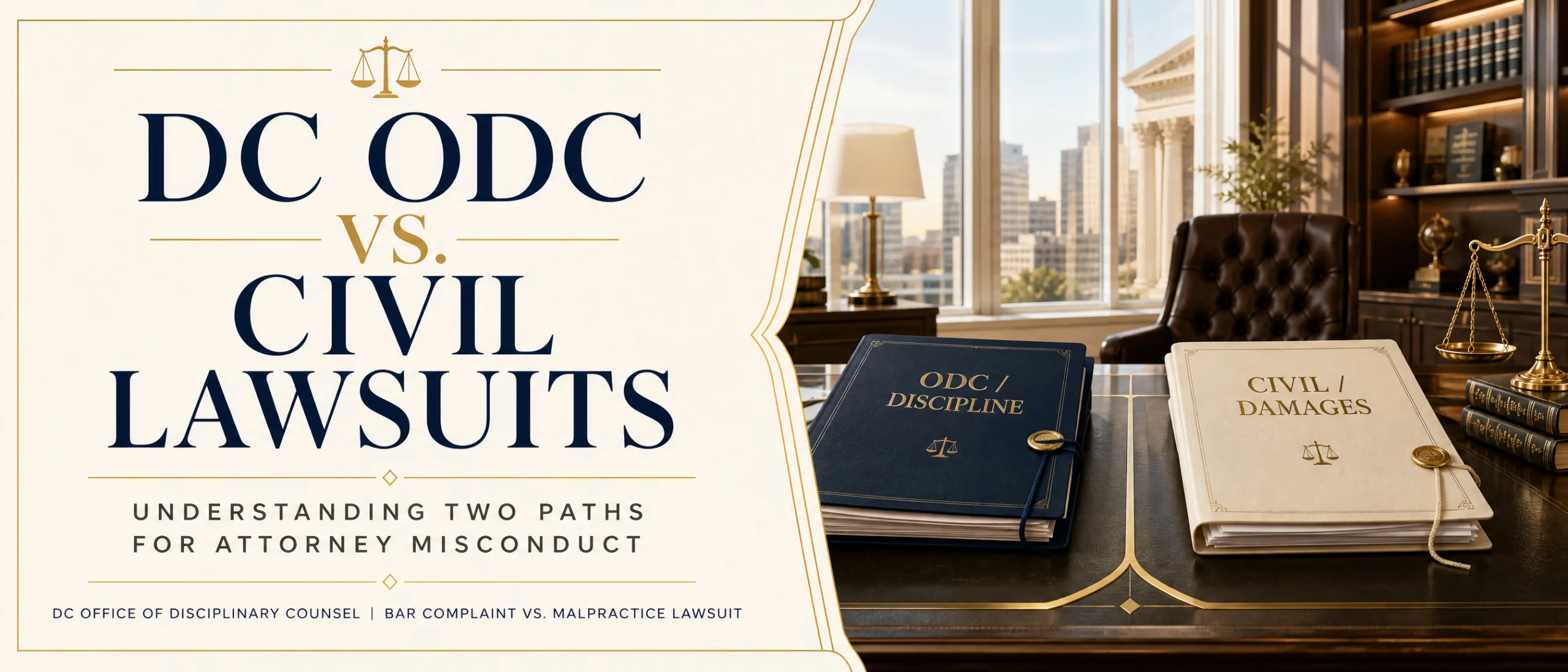
Introduction: Two Paths for Addressing Attorney Misconduct
When concerns arise about an attorney’s conduct, clients and other attorneys often face an important decision. Should the issue be reported to a disciplinary authority, or should it be addressed through a civil lawsuit?
In Washington, DC, these paths serve different purposes. The DC Office of Disciplinary Counsel handles complaints involving professional conduct, while civil courts address claims involving damages.
Understanding the difference between filing a bar complaint in DC and pursuing a malpractice lawsuit is essential when evaluating how to respond to potential misconduct.
What the DC Office of Disciplinary Counsel Does
The DC Office of Disciplinary Counsel (ODC) investigates allegations of attorney misconduct and enforces the Rules of Professional Conduct.
When a complaint is submitted, disciplinary counsel reviews the allegations, gathers information, and determines whether further action is warranted.
The DC Courts system explains that disciplinary counsel investigates complaints and prosecutes violations before the Board of Professional Responsibility.
The purpose of this process is not to compensate individuals but to regulate attorney conduct and maintain professional standards.
Filing a Bar Complaint in DC
Filing a bar complaint in DC begins by submitting information to the Office of Disciplinary Counsel. Complaints may involve issues such as conflicts of interest, mishandling client funds, lack of diligence, or failure to communicate.
Once a complaint is filed, the ODC evaluates whether the allegations fall within its jurisdiction and whether they warrant investigation.
The process may involve reviewing documents, requesting responses from the attorney, and gathering additional evidence.
Not every complaint results in formal discipline. Some matters are dismissed if the conduct does not violate professional rules or if there is insufficient evidence.
Understanding the Attorney Discipline Process
The attorney discipline process in Washington, DC, involves several stages.
After investigation, disciplinary counsel may recommend dismissal, informal resolution, or formal charges. If charges proceed, the matter is reviewed by the Board of Professional Responsibility.
The Board evaluates evidence and makes recommendations to the District of Columbia Court of Appeals, which has final authority over attorney discipline.
This process focuses on whether the attorney violated professional conduct rules, not on whether the client suffered financial harm.
Types of DC Bar Sanctions
When misconduct is established, the court may impose DC Bar sanctions.
Sanctions can range from informal admonitions to public reprimands, suspensions, or disbarment, depending on the severity of the conduct.
The purpose of these sanctions is to protect the public and maintain the integrity of the legal profession.
Because disciplinary proceedings are regulatory in nature, they do not provide financial compensation to the individual who filed the complaint.
What a Malpractice Lawsuit Involves
A malpractice lawsuit is a civil action seeking damages for harm caused by an attorney’s conduct.
In contrast to disciplinary proceedings, malpractice claims focus on whether the attorney’s actions caused measurable financial loss.
To succeed in a malpractice claim, a plaintiff typically must establish an attorney-client relationship, a breach of the applicable standard of care, and damages resulting from that breach.
This process often involves a detailed analysis of the underlying legal matter and may require expert testimony.
Bar Complaint vs. Malpractice Lawsuit: Key Differences
The distinction between a bar complaint and a malpractice lawsuit is rooted in purpose.
A bar complaint is designed to address professional conduct and protect the public. A malpractice lawsuit is intended to address harm suffered by an individual client.
The two processes can occur independently. Filing a complaint with the DC Office of Disciplinary Counsel does not automatically result in a malpractice claim, and pursuing a malpractice lawsuit does not require filing a disciplinary complaint.
In some situations, both paths may be considered depending on the circumstances.
When Each Option May Be Appropriate
Disciplinary complaints are often appropriate when the concern involves ethical violations, such as conflicts of interest, trust account issues, or a lack of communication.
Malpractice claims may be considered when the issue involves financial harm resulting from an attorney’s actions, such as missed deadlines or mishandled litigation.
Evaluating which path to pursue often depends on the nature of the conduct and the outcome of the representation.
Professional Responsibility Guidance from The McGavock Reed Law Firm
Questions involving attorney conduct, disciplinary procedures, and malpractice claims require careful evaluation of both legal standards and the underlying facts.
The McGavock Reed Law Firm advises attorneys and clients on professional responsibility issues, disciplinary proceedings, and legal malpractice matters. The firm works with clients and attorneys navigating regulatory investigations, ethics complaints, and civil claims involving attorney conduct.
More information about the firm’s services can be found at macreedlaw.com
Conclusion: Understanding Your Options Matters
Addressing concerns about attorney conduct involves understanding the available legal paths.
The DC Office of Disciplinary Counsel provides a process for reviewing and addressing ethical violations, while malpractice lawsuits address financial harm through civil litigation.
Recognizing the difference between these options helps individuals make informed decisions about how to proceed.
For those seeking guidance on professional responsibility issues or evaluating potential claims, The McGavock Reed Law Firm provides counsel on these matters.
To learn more or request a consultation, visit macreedlaw.com or call (703) 206 -6926
FAQs
What does the DC Office of Disciplinary Counsel do?
It investigates complaints about attorney conduct and enforces professional responsibility rules.
How do I file a bar complaint in DC?
You can submit a complaint to the Office of Disciplinary Counsel for review and investigation.
What is the attorney discipline process in DC?
It involves investigation, review by the Board of Professional Responsibility, and final action by the DC Court of Appeals.
What are DC Bar sanctions?
Sanctions may include reprimands, suspension, or disbarment depending on the severity of the misconduct.
What is the difference between a bar complaint and a malpractice lawsuit?
A bar complaint addresses ethical violations, while a malpractice lawsuit seeks compensation for financial harm.


